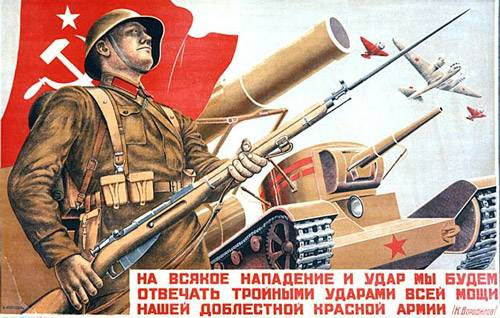
“On each and every attack our valorous Red Army will answer with three times more powerful blows!”
Most of us are familiar with the Red Army due to their infamous retaliation toward the Germans after the Battle of Stalingrad. The Red Army consisted of people who fought for more for themselves, but for sheer survival to not go quietly into the night. Often at times, I would find myself wondering how and why it took the Red Army such a long time to build up their own defense strategies against the Germans. According to Freeze, “one reason was the clearly the quality and skill of the enemy…and one of the gravest political purges of the Soviet military (Freeze, 376).” Knowing the person Joseph Stalin is, it is not surprising he would discover opportunities to thwart members within his own military.
The main issue for the Red Army to defeat the Wehrmacht was a result of lack of leadership entering the war. Stalin had over 35,000 of his military officers executed, varying in waves of mass murder during this time of military purging. What can be gathered by this is that clearly in the height of Stalinism, Stalin himself went into a state of paranoia and began ridding the creators of his own military’s operational and strategical masterminds. Without leadership, and above all high ranking leadership this would go on to prove to have severe and lasting consequences that would make Stalin ill-prepared for the war to come. The Soviets would find themselves in this war to fight with strength in numbers, and a call from all of its citizens to be active participators to bring the hammer down. The Soviets and Germans were consistent in their war plans, yet “the Soviets could field more than a million soldiers and a thousand tanks at Moscow, dug into multiple defensive lines dug by women and children (National Interest, Peck).” It’s very intriguing to think about the strength of Russia, but more importantly the measures taken that led them to prevail.
Knowing your enemy typically results in ultimate success, however the German military went into the war with a different picture painted on the Russians. Their military was very well superior at the time, however the Germans underestimated the Soviets war economy and scale of productivity. With the Soviet High Command improving throughout the war, the centralization of Soviet power proved to be a useful technique in gathering million soldiers. The Red Army during the early stages of World War II could have been an easy defeat for the Germans. Soviets were ill-prepared for another World War, however Stalin’s centralized powers for mass conscription, and management of the war economy would be utilized mechanisms to win the war at all costs. As Freeze state, “paradoxically the USSR won the war both because of and despite the Stalinist system (Freeze, 385).”
Peck, Michael. “Hitler vs. Stalin: How Russia Defeated Nazi Germany at the Gates of Moscow.” The National Interest, 15 Mar. 2019, https://nationalinterest.org/blog/buzz/hitler-vs-stalin-how-russia-defeated-nazi-germany-gates-moscow-47577.
Freeze, Gregory L. Russia: A History Third Edition . Oxford University Press, 2009.
 Max Ellis' Blog
Max, thank you for this post. I agree that Germany underestimated the determination and will power of Soviet Russia. They seemed to play the role of the underdog and despite their obstacles, were able to succeed and prevail in the war.
LikeLike
Hey Natalie, yes the German’s greatly underestimated the will power of the Red Army and their aptitude to fight against what was then the most powerful enemy man had ever seen. It’s important for us to remember the “hows” and “whys” to how the Red Army prevailed even when it seemed like they wouldn’t. Always appreciate the feedback!
LikeLike
I agree with your post and with what Natalie mentioned above! I would also add that many Germans, including Hitler, considered the Russian people to be of a sub-human nature. This resulted in the assumption that conquering Russia would be an easy feat, and contributed to what you mentioned in your post. I also agree with what you mention about the purges, and you did a nice job of incorporating the course materials into your post. Overall nice job, and I really like the featured image too!
LikeLiked by 1 person
The German’s truly believed their pincer movements and blitzkrieg tactics would result in an easy victory for themselves. This for a time proved to be the case, however the defense the Red Army stood in Moscow definitely boosted the beginning of the end for the Germans. With the loss of most of their military leadership, it is amazing what few can do to supplement a call of duty for freedom for a large army composed of the ordinary Russian!
LikeLike
Thanks for raising these very important issues! The poster you lead with is really appropriate to what seems to be a main theme of your post — that the Red Army had superior strength in numbers and production to meet the challenge of the German war machine. Your post confirms the quote from Fuller you cite at the end: that Soviet victory came both because of and despite the Stalinist system.
LikeLike
Afternoon Dr. Nelson,
I am pleased the graphic depicted the message I was aiming for when writing this post. The Stalinist system went on to show how it played a two-sided role when the Red Army was fighting for their lives against the Germans. As always, good to receive your feedback and thank you for the suggestions you made this past week.
LikeLiked by 1 person
Max, this is a very interesting post. It is amazing how the Soviet Union was able to rebound from initial setbacks by the German army (and Stalin himself when considering his purge of his officer corps) to fully mobilize and overwhelm the German war machine. How do you think the war on the eastern front would have progressed if Stalin had not purged his own military and the Red Army had been fully mobilized at the time of Hitler’s Operation Barbarossa? Great post!
LikeLike
I feel as if the Red Army may have stood a chance initially against the Germans, however I think the scramble for leaders and the citizens of Russia taking up arms after considerable losses made them stronger. If Stalin was unhappy with his military leadership they may have ended up in the same fate, and resulted in no leadership and probably would have lost the war. We will never know, but it is important to remember the German army could not withstand the harsh winters of the country. That is something to think about.
LikeLiked by 1 person
Every time I read things like these about Stalin, whether I have heard that description before or not, I am always stunned at how Stalin was able to be successful. His leadership style definitely struck fear into those under him but it should have struck fear into him as well once he saw that executing a bulk of your military officers had some negative effects. Clearly though, the main just kept his eyes looking forward and didn’t really care to reap the consequences of his actions.
LikeLike
It is also crazy to think the Western powers would even sit at the table with Stalin after these acts, and even when he initially sided with the Axis powers. The strange things about diplomacy in times of war continues to amaze me. However, it was good for the period of time where we had the Red Army on our side to put pressure on the Germans. At the end of the day Stalin’s Russia would not last, nothing so totalitarian could ever survive forever.
LikeLike
Very entertaining post, its always just so interesting to me how the Red Army came back in full force to defeat the Germans considering they just had the better military for so long. I also really “like” the part about the women and children digging trenches to hold off the Germans. I think in a way shows just how much the people of Russia were set on winning You know that and the thousands of tanks and millions of soldiers.
LikeLike
It’s intriguing how citizens who lived in a country where they really were displeased with their government were still willing to be part of the war effort. It clearly illustrates my last point in the article, “paradoxically the USSR won the war both because of and despite the Stalinist system.” The German’s really didn’t truly have anything to fight for, only based on the orders of Hitler.
LikeLike
Max, good post this week. Yeah it’s crazy how bad the Germans underestimated the Red Army. But at the same time the Soviets almost lost their country too. Freeze said the Red Army had like 2.8 million troops around their border. That’s crazy how they were just swept aside.
LikeLike
The offensive strategies of the German army were unparalleled for its time. Prior to the invasion of Russia, the German army took out a lot of air bases and places that would’ve been able to provide a better defense for the countryside. This made the Russian’s ill-equipped with air planes, tanks, and basically most mechanized weapons of warfare that would have made them stand a better chance. Eventually, the Russian’s built infrastructure that would make them more able to defend themselves. Still wild though.
LikeLike