Featured

Carpenters of Samarkland

Carpenter. Samarkand
Prokudin-Gorskii, Carpenter, Samarkand, 1905

During this period of the Russian Empire the dynastic system in place had a clear distinction among the hierarchy of social classes. This, followed by rapid economic change within the Empire as the the economy wanted to grow and expand itself, along with the transcontinental railroad. Depicted in the photograph above is a carpenter in a very colorful robe surrounded by large logs of wood. Russia was very keen on its Central Asian territories it had acquired during its conquest in the annexation of this region in 1895. After the expansion of the Russian Empire into Central Asia, this would allow for a secure frontier and create opportunities for the Russians to capitalize on resources within the area.

What is intriguing about this period of time in the Empire is the Russians utilized anyone that fell under their rule. The man depicted in the photograph became another means of production that the Empire would utilize to further deepen their ties into the Central Asian region. Territories gained such as Uzbekistan and Turkmenistan allowed for the Russians were utilized for the benefits of the entire Russian Empire. Through my research, knowledge gained is that these locations served as strategic points of location surrounding bodies of water, in order to keep the prosperity of Great Britain within economic checks. What is intriguing through my findings, is that the expansion of Russian influence within the Central Asian region is it truly highlights the level of impact the Empire was attempting to gain throughout all of Europe and the Caucasus area.

The image gives the audience a glimpse into what early 20th century Russia was like for those who did not fall under elite social classes. The Russian Empire was under radical social and economic change during this time period, so what is seen is what we can visually grasp about early 20th century Russian history. What I took from this image is the impact a foreign entity can have on an entire population, the strength of Russia’s political foothold is prominent and had lasting effects on those of peasantry. Lessons learned from early Russian influence is that as history shows that those who use their political power for economic gain enter a self-fulfilling loop of losing to the general population. As Empires rise, Empires will fall, social slavery will eventually lose to the revolution of the people affected by a negative political entity.

Works Cited

Gregory L. Freeze, Russia A History

Detente: Was it really relaxed?

Cold War : Detente and the Thaw flashcards on Tinycards
Cold War: Detente and the Salt, Ayman Hazwani

For many, this time in Soviet history is seen as a time of relaxation in international relations between the U.S. and Soviets. When I think about this time it isn’t merely a period of relaxation, but a conditional era of co-existing between two superpowers. The Cold War was never really cold, it had seen many accounts in its era where things could intensify between the two nations. Space races, improvements in technology, and involvement in the international arena are not necessarily ‘cold’ movements in a period of ‘relaxing’. Freeze states that the point of detente from a Soviet prospective was, “to counteract the international furore over the invasion of Czechoslovakia in 1968 (Freeze, 445.)” An invasion of another country is not relaxed, however the personality of the Soviet government needed to align itself with another international powerhouse to pursue common interests. Detente is one of the most intriguing maneuvers the Soviet’s utilized in their effort to improve its reputation on an international level.

On the home front, the Soviet Union experienced its own issues, “the decline in the industrial growth…a command economy with all its inefficiencies compounded by the incompetence of a superannuated leadership (Freeze, 442).” Furthermore, as detente became part of the USSR’s policy with the U.S., efforts to enhance collaboration were apparent. The SALT-I treaty was one step in a collaborative effort to set limits on offensive missiles and anti-ballistic missiles for the next five years. On the international scene, this was a tremendous achievement on both sides from lessons learned in World War II.

As time progresses, conflict will progress with it, and the 1970s involved a large amount of instability in conflict within regions of the world. The Vietnam war being one of these issues, we can see the USSR become more involved in its increased presence within underdeveloped countries. In addition to this period of eased tension, it’s intriguing to note that the USSR had goals to improve their relations with the Chinese government. Improved relations between China and the USSR was unsuccessful, as well as their goals to create greater authority within Asia. Detente was a conditional period, and to not achieve significant improvements for the interests of the USSR would lead to the end of detente. At the end we see the Soviet Union electing to intervene militarily in Afghanistan for its strategic importance. Detente would end and carry onward with the Soviet Union into a period of dissent, consuming resources and the lives of Soviets that would prove to have horrible effects.

Freeze, Gregory L. Russia: A History Third Edition . Oxford University Press, 2009.

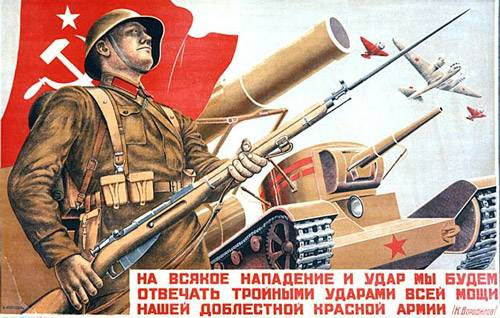
The Hammer Strikes

On each and every attack our valorous Red Army will answer with three times more powerful blows!
https://www.allworldwars.com/Russian%20WWII%20Propaganda%20Posters.html
“On each and every attack our valorous Red Army will answer with three times more powerful blows!”

Most of us are familiar with the Red Army due to their infamous retaliation toward the Germans after the Battle of Stalingrad. The Red Army consisted of people who fought for more for themselves, but for sheer survival to not go quietly into the night. Often at times, I would find myself wondering how and why it took the Red Army such a long time to build up their own defense strategies against the Germans. According to Freeze, “one reason was the clearly the quality and skill of the enemy…and one of the gravest political purges of the Soviet military (Freeze, 376).” Knowing the person Joseph Stalin is, it is not surprising he would discover opportunities to thwart members within his own military.

The main issue for the Red Army to defeat the Wehrmacht was a result of lack of leadership entering the war. Stalin had over 35,000 of his military officers executed, varying in waves of mass murder during this time of military purging. What can be gathered by this is that clearly in the height of Stalinism, Stalin himself went into a state of paranoia and began ridding the creators of his own military’s operational and strategical masterminds. Without leadership, and above all high ranking leadership this would go on to prove to have severe and lasting consequences that would make Stalin ill-prepared for the war to come. The Soviets would find themselves in this war to fight with strength in numbers, and a call from all of its citizens to be active participators to bring the hammer down. The Soviets and Germans were consistent in their war plans, yet “the Soviets could field more than a million soldiers and a thousand tanks at Moscow, dug into multiple defensive lines dug by women and children (National Interest, Peck).” It’s very intriguing to think about the strength of Russia, but more importantly the measures taken that led them to prevail.

Knowing your enemy typically results in ultimate success, however the German military went into the war with a different picture painted on the Russians. Their military was very well superior at the time, however the Germans underestimated the Soviets war economy and scale of productivity. With the Soviet High Command improving throughout the war, the centralization of Soviet power proved to be a useful technique in gathering million soldiers. The Red Army during the early stages of World War II could have been an easy defeat for the Germans. Soviets were ill-prepared for another World War, however Stalin’s centralized powers for mass conscription, and management of the war economy would be utilized mechanisms to win the war at all costs. As Freeze state, “paradoxically the USSR won the war both because of and despite the Stalinist system (Freeze, 385).”

Peck, Michael. “Hitler vs. Stalin: How Russia Defeated Nazi Germany at the Gates of Moscow.” The National Interest, 15 Mar. 2019, https://nationalinterest.org/blog/buzz/hitler-vs-stalin-how-russia-defeated-nazi-germany-gates-moscow-47577.

Freeze, Gregory L. Russia: A History Third Edition . Oxford University Press, 2009.

m.A.A.d soviets

A Tale of Two Constitutions, Kuchar Constitutionalist

After the death of Vladimir Lenin began an era of socialist construction that would put Stalin’s vision of Russia would be shown to all of its citizens. During this time in Soviet history is where we truly see Stalinism and the collectivization of agriculture and building a modern industrialized economy at its peak. Human capitalism was its most precious commodity to build socialism in his vision of Russia, processing his citizens to become products of his socialist society.

The Stalin Constitution could be seen as revisionism in policy to secure the operational status of Russia’s main economic pillar, agriculture. Issues that rest in policy are a product of the reaction of its citizens, being that the constitution made it clear how consolidated power was within the government (Qian, 4). Change in the governments policy in regard to agriculture, led to social consequences of fear by the lower class. This resulted in a lack of confidence in productivity that would make agricultural supply sources short. Resistance and rebellion by the lower class were large in commonality to avoid further repression by the government, furthering the gap between government and citizens.

Famine and harsh working conditions were not merely undertones in the early to mid 1930s, they were catalysts that enabled the political intervention by the government. Essentially, implementing policy such as the Stalin Constitution are political examples of mending communism and socialist capitalism into one gigantic failure. The harsh reality sinks with the peasantry, as this era is garnered as a “war on class,” (Freeze, 343.) The effects of the Great Purges and Stalin Constitution rested its demise on the peasantry leaving the intelligentsia and nobility in a state of comfort. Stalin’s regime was a totalitarian force that used repressiveness as a manifestation to act on the collectivization of agriculture, and ultimately all of society. Labour camps affected millions of lower class citizens, the use of their small plots of land were consequentially bartered for equipment and profits made were rendered back to the government (Freeze, 347.) Resistance became a commonality signifying a calculated intensification on the war of survival under Stalin’s regime, and most of the time being defeated by their ruler.

Qian, Jingyuan. A Brief Research on 1936 Soviet Constitution under Joseph … 2 Feb. 2012, digitalcommons.macalester.edu/cgi/viewcontent.cgi?article=1018&context=macreview.

Freeze, Gregory L. Russia: A History Third Edition . Oxford University Press, 2009.

Welcome to my Blog!

My name is Max Ellis and welcome to my blog for this semesters class on 20th Century Russia. I am from Norfolk, VA, a graduate of Granby High School in 2016. My major is Political Science: National Security Studies, and this semester will be my last as an undergraduate here at Virginia Tech. The topic of Russian history has always been something that has captured my attention since the early days of middle school, learning about the Soviet Union. With it being my last semester, I truly wanted to broaden my horizons through being a part of this class. I hope you enjoy my blogs, and I look forward to a great last spring here.

Design a site like this with WordPress.com
Get started